
A virtual beauty consultation with AI helps beauty brands and retailers connect visible facial cosmetic concerns with relevant products from their own skincare catalog. Skinive Face Scanner can provide image-based cosmetic insights and product matching based on skin type, concern severity, product purpose, INCI ingredients and ingredient restrictions. Customers can use the experience independently, with a beauty advisor, or in a hybrid journey; facial analysis does not replace medical diagnosis or human understanding of preferences.
The result can be self-service, advisor-assisted or hybrid. The goal is not simply to analyze a face, but to turn beauty insights into a useful product conversation and clear next step.
Last updated: November 20, 2026
Key Takeaways
- Virtual beauty consultation does not necessarily mean a live video call; it can be self-service, advisor-assisted or hybrid.
- AI face analysis can provide a consistent visual starting point based on supported cosmetic characteristics.
- Human advisors remain useful for preferences, routines, budgets, product comparison and conversational context.
- The strongest consultation connects beauty analysis with an actionable next step such as relevant product discovery.
- Skinive Face Scanner can work with a beauty brand or retailer’s own skincare catalog.
- Skinive currently provides a Web Widget, Web SDK and API; native iOS and Android SDKs are planned.
- Skinive provides analytics for scans, users, product clicks and sales conversions; additional consultation metrics depend on the business’s own analytics.
- Skinive Face Scanner is designed for beauty, cosmetics and personalized skincare rather than medical diagnosis.
What Is a Virtual Beauty Consultation?
A virtual beauty consultation is a digital or digitally assisted experience that helps customers understand beauty needs, explore relevant products and make more informed skincare decisions.
It does not have to involve a live beauty advisor.
A consultation can happen through a self-service digital experience, with assistance from a beauty advisor, or through a combination of both.
The defining feature is guidance.
Instead of simply presenting a large product catalog, the experience helps move the customer through a structured journey:
Understand Beauty Concerns → Add Relevant Context → Discover Products → Decide What to Do Next
AI face analysis can provide the visual starting point for that journey.
How Is AI Changing the Beauty Advisor Experience?
AI introduces a structured and repeatable digital layer into a process that has traditionally depended heavily on conversation and an advisor’s visual assessment.
With an AI-powered Face Scanner, customers can capture facial images and receive beauty-focused analysis of supported visible characteristics.
That information can then become an input into product discovery or an advisor conversation.
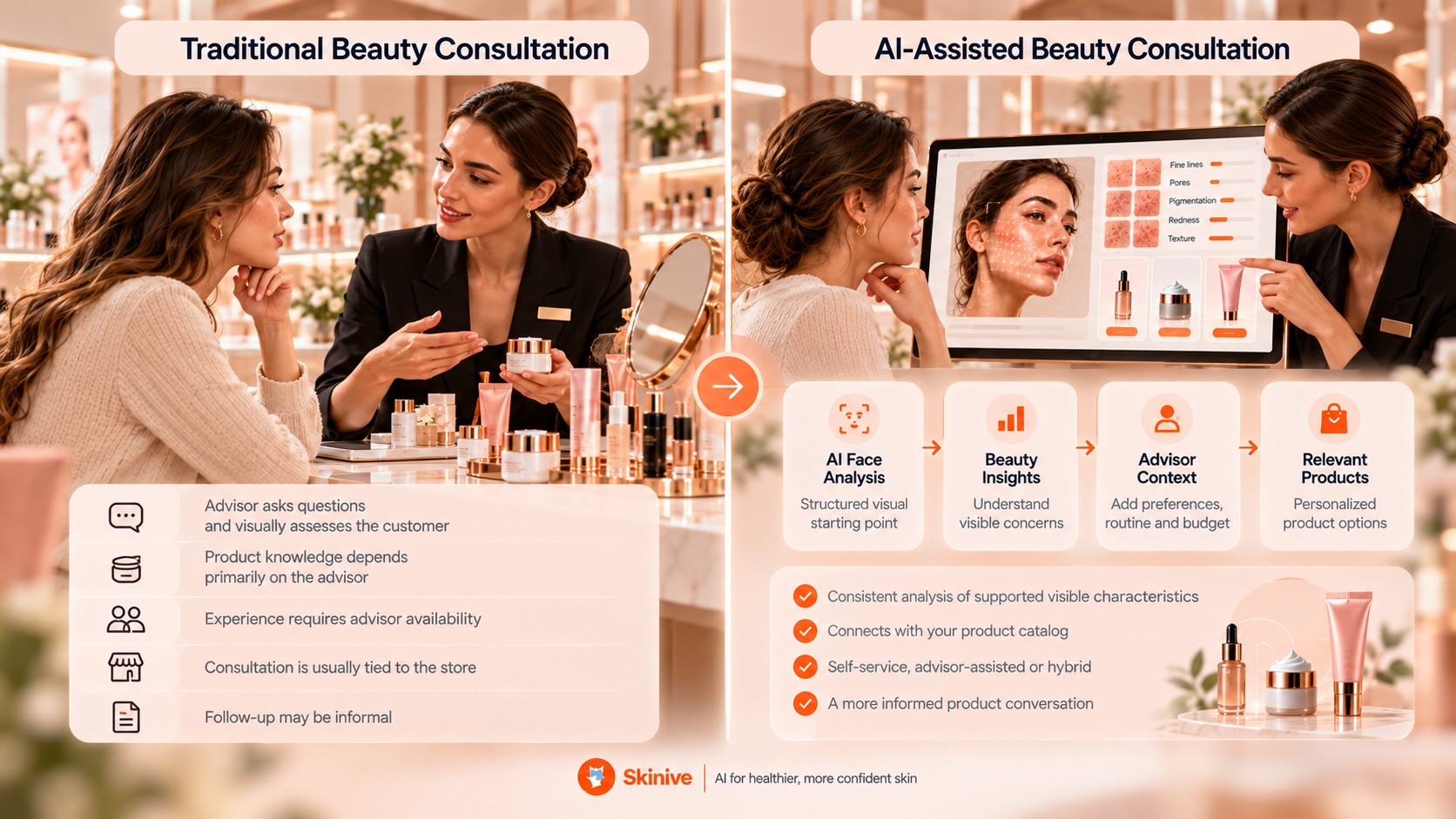
| Traditional Beauty Consultation | AI-Assisted Beauty Consultation |
|---|---|
| Advisor begins with questions and visual observation | AI can provide a structured visual starting point |
| Product discovery depends heavily on the conversation | Beauty insights can connect with product data |
| Requires advisor availability | Parts of the journey can be self-service |
| Experience is often tied to a physical consultation | Digital experience can begin across different touchpoints |
| Process may vary between advisors | Supported AI analysis can provide a consistent input |
| Strong human context | AI inputs and human context can complement each other |
The purpose of AI is not necessarily to remove the advisor.
It can change what the advisor needs to spend time doing.
AI Does Not Have to Replace the Beauty Advisor
A more useful question than “Can AI replace a beauty advisor?” is:
Which parts of the consultation are repeatable, and which parts benefit from human judgment and conversation?
AI can provide a repeatable visual starting point through guided image capture and analysis of supported visible cosmetic characteristics.
A beauty advisor can contribute information that facial analysis alone cannot provide, such as:
- Customer preferences
- Existing routine
- Budget
- Preferred product formats
- Previous product experience
- Desired routine complexity
- Questions raised during the consultation
This creates a hybrid model.
AI structures the visual starting point. The advisor adds customer context.
Three Models of Virtual Beauty Consultation
Beauty brands and retailers do not need to choose one universal consultation format.
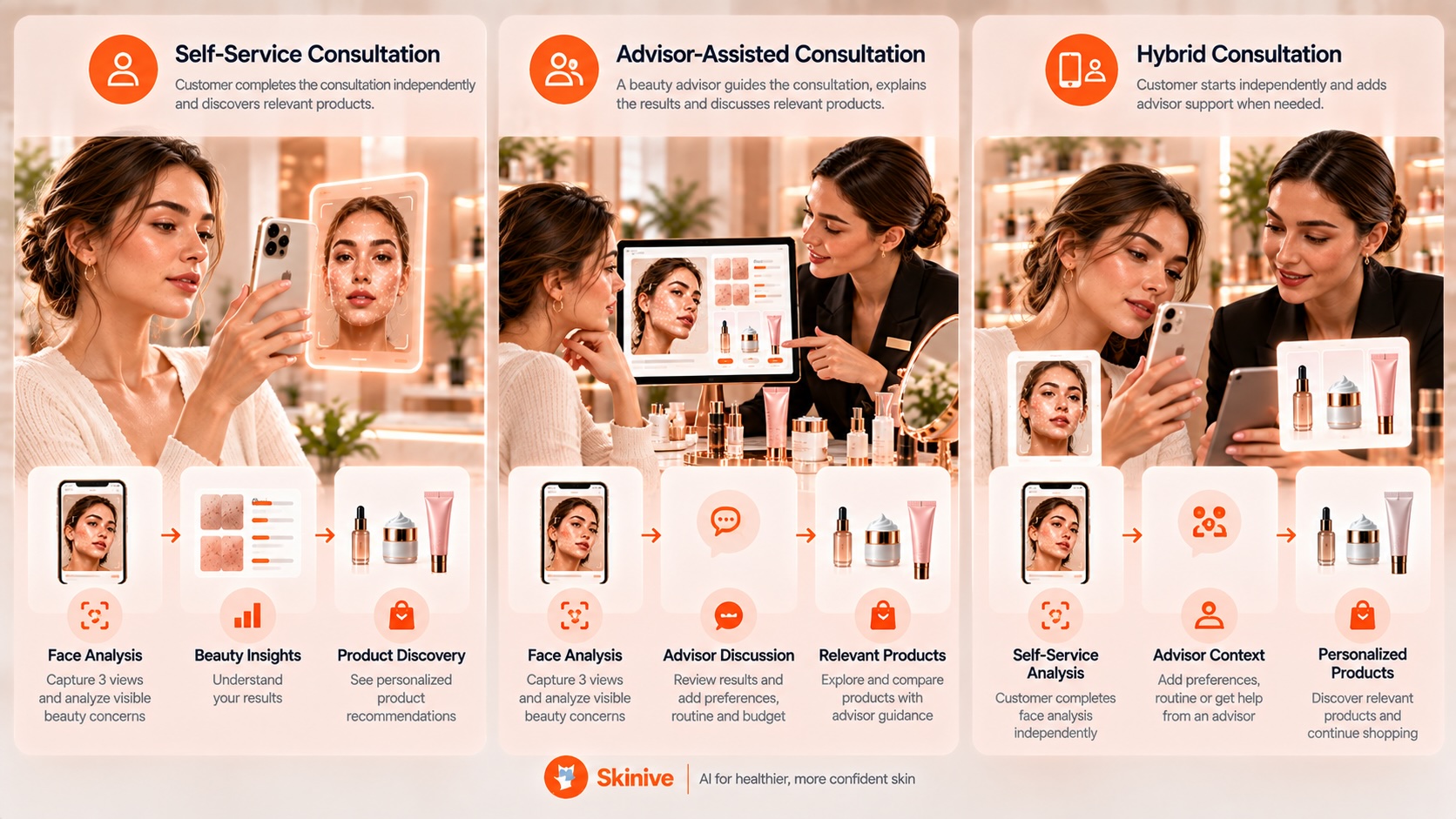
Self-Service Consultation
The customer completes the digital experience independently.
A typical journey can move from Face Scanner entry to beauty analysis and then toward relevant products.
This model is particularly suitable when customers need guidance without requiring an available advisor.
Advisor-Assisted Consultation
A beauty advisor participates in the experience.
The advisor may help the customer understand the process, discuss the beauty-focused results and add preferences or product context before exploring relevant options.
Hybrid Consultation
The customer completes part of the journey independently and receives human assistance when it becomes useful.
For example:
Self-Service Face Analysis → Beauty Results → Advisor Conversation → Product Discovery
The hybrid model allows technology to handle repeatable steps while preserving human interaction where it adds value.
How Does an AI Virtual Beauty Consultation Work?
A well-designed consultation should move from analysis toward a useful decision rather than treating the scan itself as the destination.
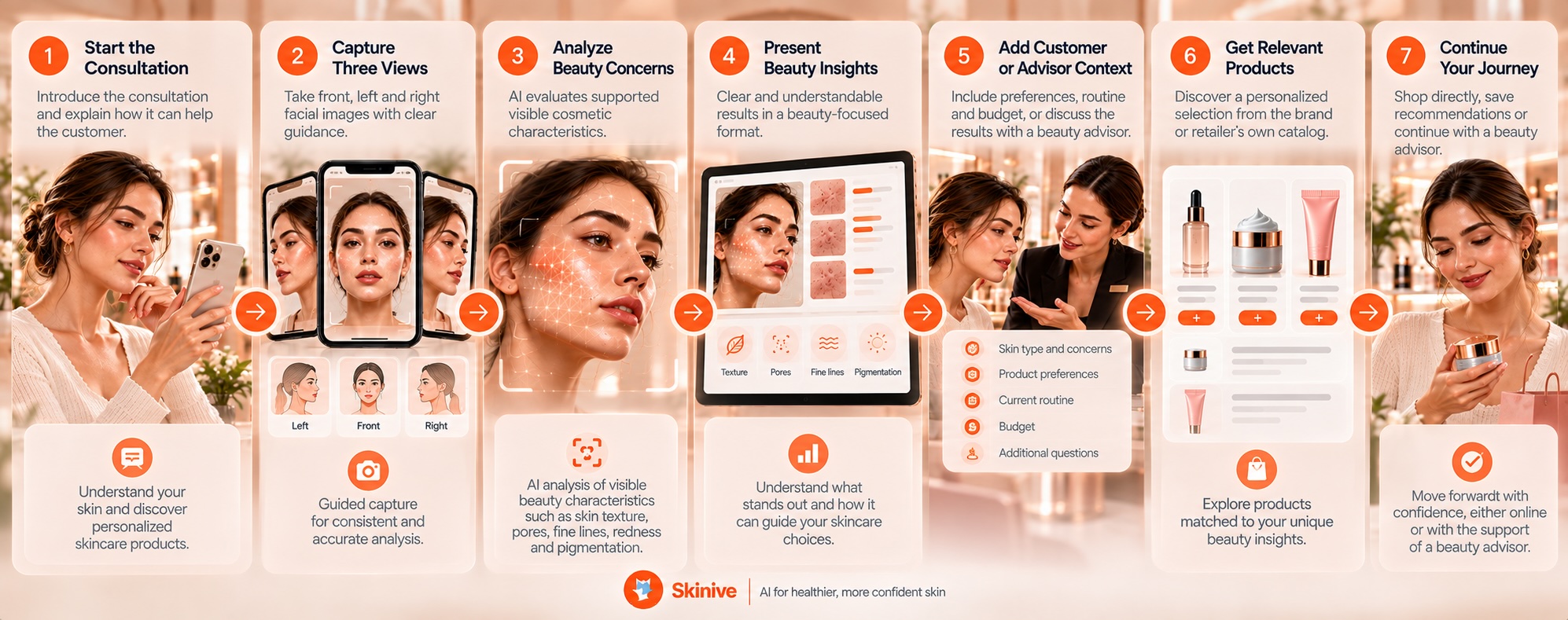
Start With a Clear Benefit
Before requesting facial images, explain what the consultation is intended to help the customer do.
The customer should understand why completing the experience is worthwhile.
Capture a Front Image, With Optional Side Views
Skinive Face Scanner requires one clear frontal facial image. Left and right profile images are optional and can add visual context when useful.
Clear capture guidance reduces unnecessary friction.
Analyze Supported Visible Beauty Concerns
AI evaluates the visible cosmetic characteristics supported by the system.
The analysis should remain clearly positioned within a beauty and skincare context.
Present Understandable Beauty Insights
Results should help the customer understand the next step rather than overwhelm them with unnecessary information.
Add Customer or Advisor Context
Facial images cannot explain every factor relevant to a product decision.
Selected questions or advisor input can add information such as preferences, routine and budget when those factors materially improve the consultation.
Connect the Consultation With Relevant Products
Beauty insights and relevant customer context can then connect with products from the business’s own skincare assortment.
Continue Toward a Decision
The next step depends on the implementation.
The customer may explore relevant products, continue shopping or discuss the options with an advisor.
The important principle is:
Analysis should lead somewhere useful.
What Can AI Face Analysis Add to a Beauty Consultation?
AI face analysis provides visual context.
Skinive Face Scanner supports analysis of multiple visible cosmetic characteristics, including concerns such as:
- Fine lines and wrinkles
- Visible or enlarged pores
- Blackheads
- Whiteheads
- Acne-related imperfections
- Dark spots and pigmentation
- Redness
- Uneven-looking facial texture
These insights can help make the consultation more specific than beginning with a completely generic product conversation.
But face analysis is only one input.
It should not be treated as a complete understanding of the customer.
Preferences, budget, routine, previous product experience and other personal shopping considerations require additional context.
For a deeper explanation of the technology, see AI Face Analysis: How It Works and What It Can Identify for Beauty & Skincare.
From Face Analysis to a Product Conversation
A consultation becomes more useful when every stage answers a clear customer question.
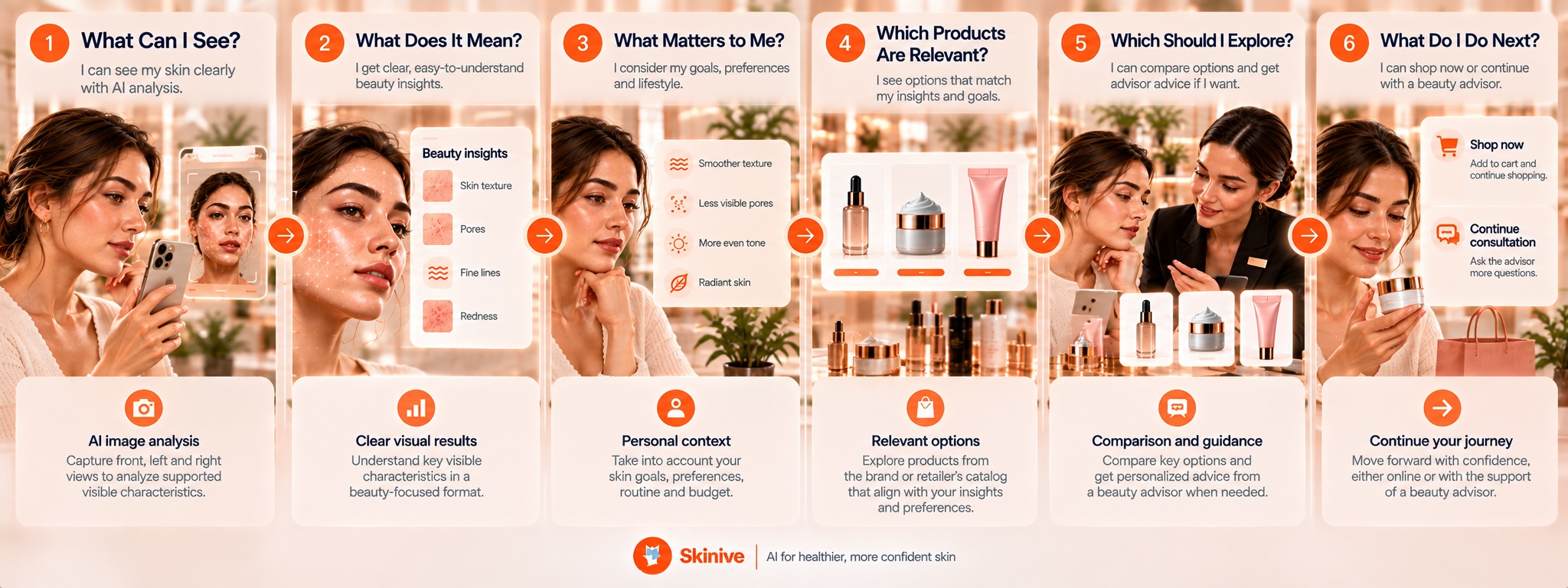
| Consultation Stage | Customer Question | Digital / Advisor Role |
|---|---|---|
| Analysis | What can I see? | AI evaluates supported visible cosmetic characteristics |
| Explanation | What does this mean in a beauty context? | Interface or advisor explains the results |
| Context | What matters to me? | Selected questions or advisor input add relevant preferences |
| Product discovery | Which products should I explore? | Product matching narrows the assortment |
| Comparison | Which option fits my needs? | Product information and advisor guidance support the decision |
| Action | What should I do next? | Continue toward relevant products or further consultation |
The experience should feel like one conversation rather than a sequence of disconnected tools.
What Should AI Handle and What Should a Beauty Advisor Handle?
The boundary does not have to be identical for every retailer.
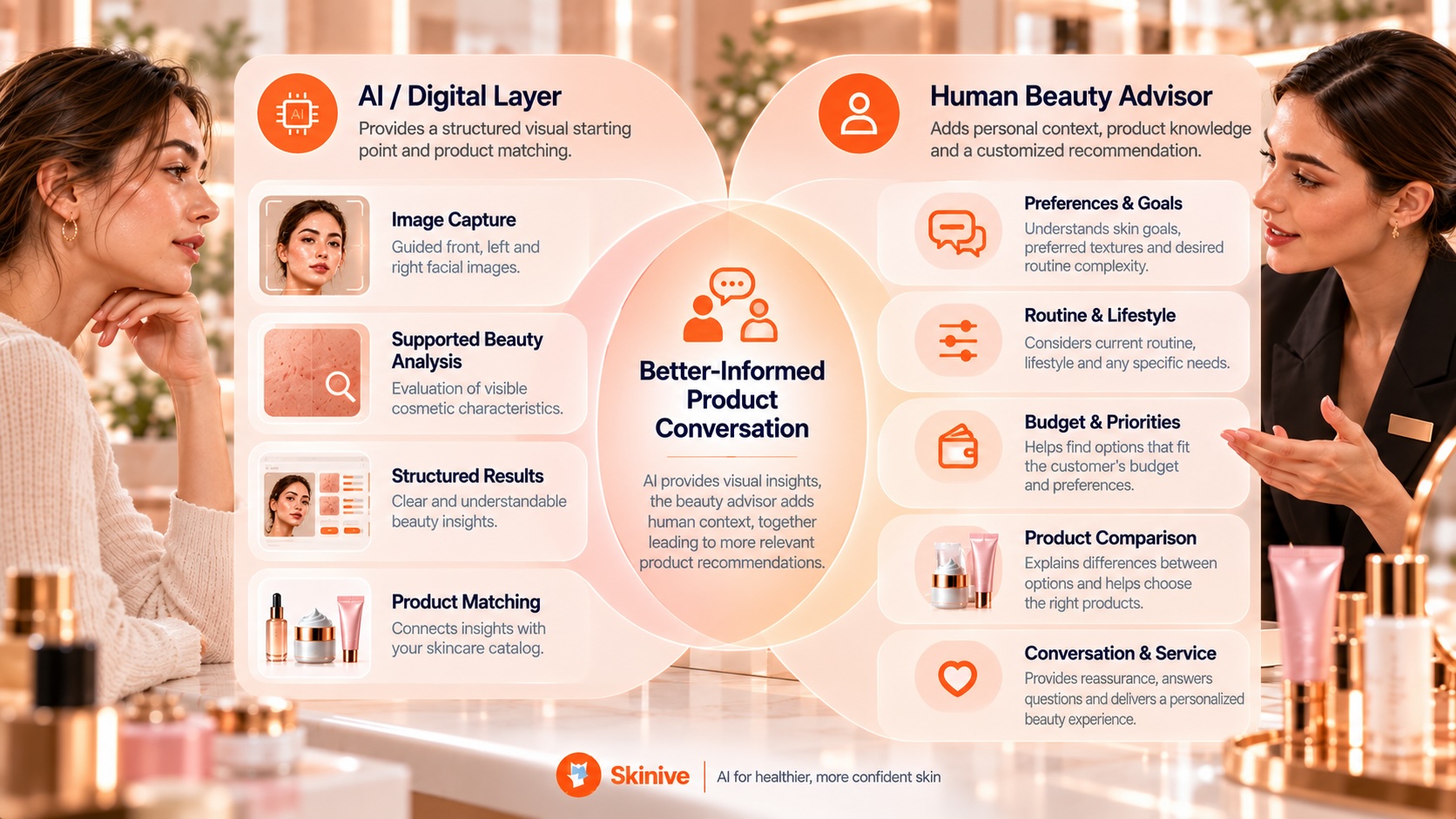
A useful starting model is:
| AI / Digital Layer | Human Beauty Advisor |
|---|---|
| Guided image capture | Assist customers when needed |
| Analysis of supported visible characteristics | Add conversational context |
| Structured presentation of beauty insights | Ask about preferences and routine |
| Connection with product data | Discuss practical product differences |
| Repeatable consultation flow | Adapt the conversation to the customer |
| Digital interaction data | Provide qualitative feedback and service |
The balance can then change according to the consultation model.
A self-service website may place almost the entire journey in the digital layer.
A premium beauty counter may use the Face Scanner primarily as a structured starting point for an advisor-led conversation.
AI Beauty Consultation vs. Skincare Quiz
Face analysis and questionnaires solve different information problems.
| AI Face Consultation | Skincare Quiz | Hybrid Consultation | |
|---|---|---|---|
| Primary input | Facial images | Customer answers | Images + selected questions |
| Visible characteristics | AI-assisted analysis | Self-reported | AI-assisted |
| Preferences | Not visible from images | Can be collected | Can be collected |
| Customer effort | Image capture | Answer questions | Both, kept focused |
| Human advisor | Optional | Usually absent | Can be added |
| Product discovery | Can connect with catalog | Can connect with catalog | Uses broader context |
The two approaches do not need to compete.
A hybrid consultation can use face analysis for visual context and ask only questions that meaningfully improve product relevance.
This avoids turning personalization into a long questionnaire.
For a detailed comparison of image-based and questionnaire-based experiences, see AI face scanner vs. skincare quiz.
How Does the Product Catalog Fit Into a Virtual Consultation?
A beauty consultation becomes commercially relevant when its insights can connect with products the business actually sells.
Skinive Face Scanner can work with a beauty brand or retailer’s own skincare catalog.
Catalog information can be imported as CSV or maintained through supported catalog APIs. Recommendations can consider skin type, concern severity, product purpose, INCI ingredients and ingredient restrictions. See how to connect a cosmetics product catalog to AI skincare recommendations.
Minimum product information includes:
- Product name
- Product description and intended use
- INCI ingredients and ingredient restrictions
- Price
- Product-page URL
Catalog updates and synchronization methods depend on the selected integration and plan.
Catalog limits and included usage depend on the current plan. See the Skinive Face Scanner plans and integration options for current details.
For a virtual consultation, the important point is simpler:
the customer should be able to move from beauty insights toward products available from the business.
What Makes a Good Virtual Beauty Consultation UX?
A consultation should reduce uncertainty rather than introduce another complicated layer into the shopping journey.
Explain the Value Before Capture
Customers should understand why they are being asked to complete the Face Scanner experience.
Make Image Capture Clear
Front, left and right capture should be easy to understand and complete.
Keep Results Focused
More information does not automatically create a better consultation.
Prioritize insights that help the customer continue.
Explain Product Relevance
A personalized product should not appear arbitrary.
The customer should understand the connection between the beauty insight and the suggested product category or option.
Keep Choices Manageable
A consultation that ends with another overwhelming product list has not solved the original discovery problem.
Preserve Normal Shopping
Customers should still be able to leave the personalized journey and browse normally.
Add Human Help Where It Creates Value
Human assistance should solve a customer problem rather than being added simply because an advisor is available.
Can AI Support a Premium Beauty Consultation?
Automation does not automatically make a beauty experience less premium.
The quality of the experience depends on how the technology is incorporated.
In an advisor-assisted environment, AI can provide a structured starting point while the human conversation focuses on elements such as preferences, product formats, routines and product comparison.
In a self-service environment, premium positioning can come from:
- Clear interaction design
- Understandable beauty insights
- Focused product discovery
- Smooth transitions between consultation stages
- Consistent brand presentation
Technology and service do not need to compete.
They can perform different roles within the same customer experience.
Where Can a Virtual Beauty Consultation Be Used?
The same consultation concept can be adapted to different customer environments.
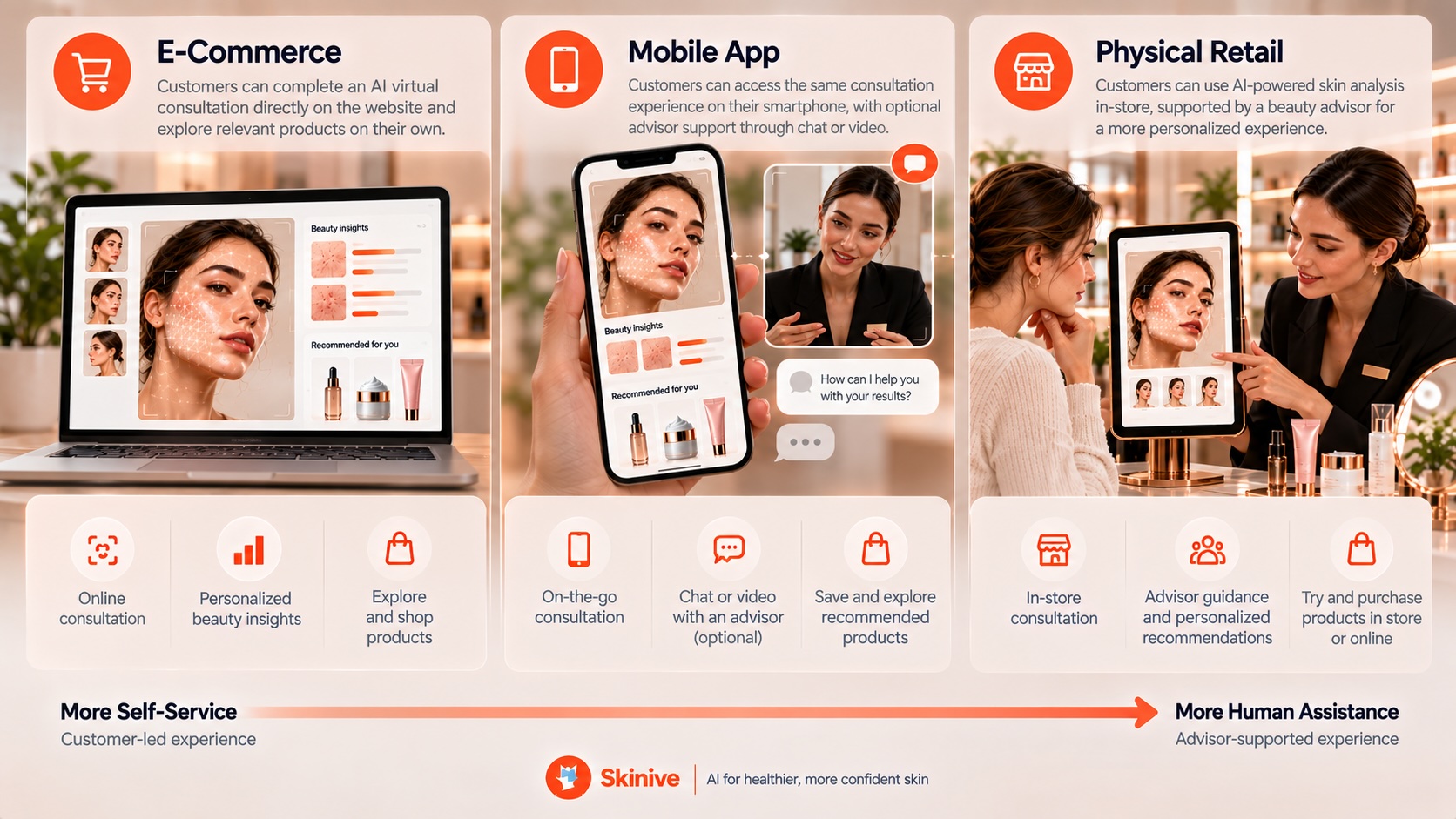
E-Commerce
A self-service consultation can help customers move from uncertainty toward relevant skincare products.
The detailed e-commerce implementation is covered in AI Face Scanner for E-Commerce: How to Personalize Skincare Shopping.
Mobile Experiences
Available integration approaches can support Face Scanner experiences within broader mobile implementations.
Skinive currently provides Web SDK and API options, while native iOS and Android SDKs are planned.
Physical Retail
A digital consultation can support self-service or advisor-assisted retail experiences on suitable devices, depending on the retailer’s implementation.
Skinive should not be assumed to provide dedicated kiosk hardware, real-time inventory, shelf-location or POS functionality.
For the detailed retail model, see AI Face Scanner for In-Store Beauty Retail: Personalized Beauty Consultations at the Point of Sale.
How Does Virtual Beauty Consultation Fit an Omnichannel Strategy?
A consultation can become a recognizable personalization concept across several customer touchpoints.
The interface does not need to remain identical.
The level of human assistance can also change.
What can remain consistent is the underlying structure:
Face Analysis → Beauty Insights → Relevant Product Discovery
A retailer can use this model across several channels without automatically linking customer identity or storing a shared Face Scanner history.
Cross-channel persistence should only be added where the implementation supports it and where it creates a clear customer benefit.
The broader architecture is covered in Omnichannel Beauty: One AI Face Scanner Across Web, App and In-Store.
How Should Beauty Brands Measure Virtual Consultation Performance?
Measurement should follow the consultation journey.
Skinive scan and analysis usage reporting can be combined with retailer-side analytics to measure:
- Scans
- Users
- Product recommendation interactions recorded by the retailer
- Sales conversions attributed through connected retailer analytics
Other metrics depend on the surrounding implementation and the business’s own analytics.
| Consultation Stage | What a Business May Evaluate |
|---|---|
| Entry | Interaction with the consultation entry point |
| Start | Consultation starts |
| Capture | Completion and abandonment |
| Results | Interaction with the results experience |
| Recommendations | Product interaction |
| Commerce | Downstream shopping behavior |
| Advisor-assisted journey | Advisor usage and consultation outcomes where measurable |
Not every metric in this table is provided by Skinive. For a structured pilot and measurement approach, see the business case and ROI of AI beauty technology.
Website, app, retail, CRM, loyalty or POS measurement may require the business’s own analytics systems.
Measuring Self-Service and Advisor-Assisted Consultations Differently
The success criteria should reflect the consultation model.
For self-service, the business may focus primarily on whether customers successfully move from entry through analysis and toward relevant products.
For advisor-assisted experiences, quantitative analytics can be combined with qualitative questions such as:
- Are advisors actually using the tool?
- At what stage does it help the conversation?
- Where do customers need additional explanation?
- Does the digital flow fit naturally into the consultation?
- Which parts create unnecessary friction?
This distinction matters because an advisor tool and a self-service product-discovery experience do not necessarily solve the same operational problem.
Privacy and Trust in AI Beauty Consultations
Virtual consultation can involve facial images and other customer information, making transparency an important part of the experience.
Businesses should review implementation-specific requirements relating to consent, data processing, storage, retention, security and applicable privacy obligations.
The amount of information collected should reflect the intended customer experience.
Additional questions, customer identity or cross-channel persistence should not be added simply because more data could theoretically be collected.
The product scope should also remain clear.
Skinive Face Scanner is designed for beauty, cosmetics and personalized skincare. It should not be presented as diagnosing skin disease, prescribing treatment or replacing professional healthcare advice.
How Skinive Supports Virtual Beauty Consultation
| Capability | Skinive Face Scanner |
|---|---|
| Face capture | One frontal image required; left and right profiles optional |
| Beauty analysis | 23 cosmetic concern categories; up to 10 image-supported findings |
| Product catalog | CSV import and supported catalog API functions |
| Minimum catalog data | SKU, name, intended use, INCI ingredients, description and product URL |
| Catalog synchronization | Catalog updates subject to integration and plan requirements |
| Web Widget | Available; setup time depends on the website and integration |
| Web SDK | Available |
| API | Available |
| Native iOS SDK | Planned |
| Native Android SDK | Planned |
| Analytics | Scan and analysis usage; commerce attribution through retailer analytics |
These components can become part of self-service, advisor-assisted or hybrid beauty journeys depending on the business’s implementation. See how to integrate an AI face scanner into a website for technical options.
A Practical Virtual Beauty Consultation Rollout
A useful consultation does not need to begin as a large omnichannel project.
Define the Customer Problem
Start with a specific reason customers need guidance.
For example, they may struggle to choose among a large skincare assortment.
Choose the Consultation Model
Decide whether the first implementation should be:
- Self-service
- Advisor-assisted
- Hybrid
Define the Role of AI
Identify which repeatable parts of the journey should be handled digitally.
Define the Role of Human Guidance
If advisors are involved, determine exactly where their contribution improves the customer experience.
Connect the Product Catalog
Ensure the products used for discovery are current and appropriately described.
Build a Short Journey
Keep the path from entry to beauty insights and relevant products understandable.
Launch in One Environment
Begin with one customer journey rather than attempting every channel simultaneously.
Measure the Experience
Use Skinive’s available analytics together with the business’s own relevant measurement.
Gather Human Feedback
For advisor-assisted implementations, learn how staff and customers actually use the experience.
Expand From Evidence
Refine the consultation before adapting it to additional channels or customer journeys.
Common Virtual Beauty Consultation Mistakes
Treating Face Analysis as the Entire Consultation
Analysis should lead toward useful guidance or product discovery.
Trying to Automate Every Human Interaction
Some customer questions are better handled through conversation.
Asking Too Many Questions
Additional context is useful only when it materially improves the experience.
Showing Too Many Results
More beauty insights can increase complexity instead of reducing it.
Recommending Too Many Products
A long personalized list can recreate the same choice overload the consultation was supposed to solve.
Failing to Explain Product Relevance
Customers should understand why a product is being presented.
Mixing Beauty and Medical Positioning
A cosmetic consultation should not drift into diagnosis or treatment claims.
Assuming Commercial Impact
Conversion, advisor efficiency or other business improvements should be measured rather than assumed.
Related Resources
- How AI Face Analysis Works
- AI Skincare Recommendations
- Personalized Skincare With AI
- AI Product Recommendation Engine for Beauty
- AI Face Scanner for Beauty Apps
Create an AI-Powered Beauty Consultation Around Your Products
Combine AI-powered facial beauty analysis, your own skincare assortment and the appropriate level of human guidance to create a more structured beauty consultation.